String Quartet
What the Snow Kept for Her
- Ensemble
- String Quartet
- Instruments
- Violin, Viola, Cello
- Genre
- Classical / Early Romantic
- Level
- Intermediate
- Duration
- about 3:59
- Pages
- 15 pages
- Catalog no.
- AP-24Y39
About this piece
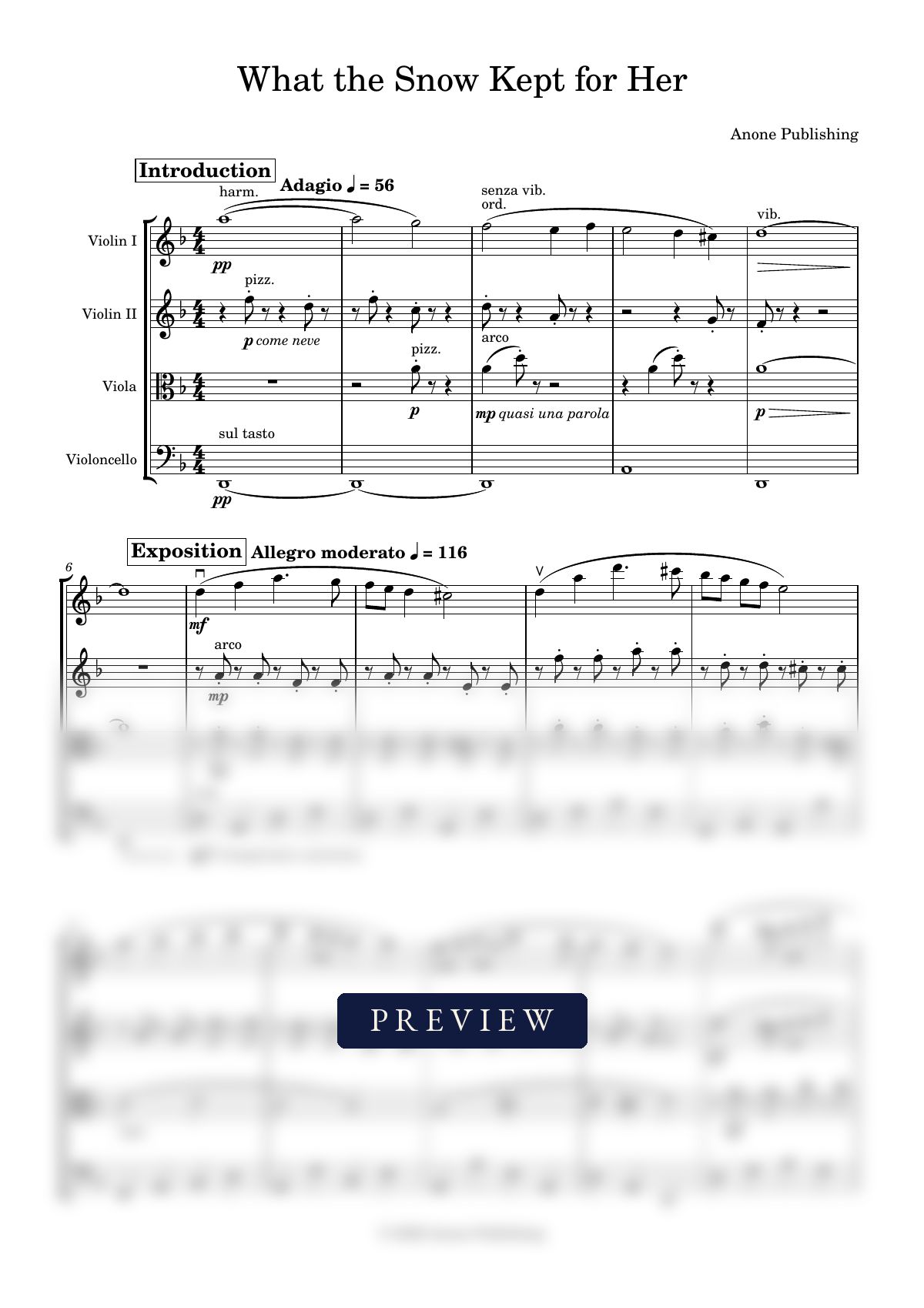
This single-movement D-minor sonata for string quartet grows from a winter tale: in a northern town, words spoken outdoors freeze into small beads in the snow, and a lamp-maker gathers the ones the lamplighter leaves at her door each night. After a hushed Adagio of harmonics and falling pizzicato, the Allegro sets the lamplighter walking in steady cello quarter notes while the inner voices flicker on the offbeats like lamps being lit. The second theme opens with a three-note descent standing for an unspoken "I love you," passed from first violin to viola before the cello takes it once, alone in its tenor register. A sul ponticello tremolo and a long, high first-violin note drive the development to its peak, and the recapitulation turns the confession to warm D major. The coda asks for real patience: the viola's broken-off leap is finally allowed to finish, and the pizzicato bells thin out until a single harmonic A is left.
The story
Read the story
In Harun, a town in the far north, voices freeze in winter.
Words spoken out of doors harden along with the white breath that carries them. They become small beads, like drops of glass, and fall into the snow at the speaker's feet. When spring comes, the beads melt, and only then do the words make a sound. So all winter long, the people of the town say what matters indoors. Out in the street they say only two kinds of things: greetings anyone may hear, and words meant for no one at all.
It was on the first morning of December that Mira, who kept the lamp shop, found a blue bead in the snow in front of her door.
It was no bigger than a fingertip, with a single thin thread of light running through it. She picked it up and cupped it in her palm. Her warmth seeped into it, and it gave a faint shiver.
"...Glad the light's still on tonight."
A low man's voice sounded once, close to her ear, and the bead turned to water and was gone.
Mira stood looking at her wet palm for a long while.
The next morning there was another bead.
"You've repainted the letters on the sign."
And the morning after that.
"Cold. But it's a little brighter, here in front of this place."
It was always the same voice, and the words were always few. Someone passing the shop at night was saying one thing to its closed door and walking on. Each morning Mira picked up the bead, warmed it, and listened. Once she had heard it, the bead was gone. There was no way to keep one. Left frozen, a bead would last, but then she could never know what it held.
Not many men in town were out at night. A craftsman on his way home from the tavern, perhaps, or the watchman on the river, or the lamplighter who went round topping up the street lamps with oil.
The lamplighter Mira did know. He was one of her customers, a tall man of few words who came in for wicks and oil. His name was Torval. He ordered the same thing every time, always paid the exact amount, and lowered his eyes when she thanked him. She had hardly ever heard his voice. "Two bundles of wick," and "Thanks," and that was about all.
That was not enough to compare.
In the middle of December, there was one morning when two beads lay in the snow.
The first sounded the way they always did.
"That blue lamp in the window, is it new? Good color."
When she warmed the second, the voice paused before it spoke.
"So come spring, all of this gets heard out loud? ...That would be a problem."
Mira laughed out loud before she could stop herself. Then, a moment later, something in her chest drew tight.
He was speaking as if the words would melt and sound out in spring. He believed no one picked them up. He did not know that she gathered them every morning.
Should she tell him? If she did, he would surely stop saying anything at all.
Mira decided to leave the blue lamp in the window burning all night. That would be her answer.
The new year came, and when the snow lay at its deepest, Torval came into the shop.
"Two bundles of wick."
The usual order. As she gathered the bundles, Mira tried to listen to his voice for longer than usual. But a voice inside the shop rang differently from a frozen one. The voice that came from the beads was closer, and softer.
"Thanks."
He set down the money and left. Only after the bell over the door had stopped ringing did Mira realize she had been holding her breath.
That night she did not sleep.
She put out the lamps and waited at the back of the shop, watching the street through the little window in the door. The snow had stopped, and the air was so cold it seemed stretched tight.
Some time after midnight, a figure with a long pole over one shoulder came up the far end of the street. He walked slowly, lighting the street lamps one by one. In front of the lamp shop, he stopped.
He looked up at the blue window and said something.
She saw his white breath harden, and a single small light dropped onto the snow.
Mira opened the door.
The bell rang. Torval froze where he stood, pole in hand.
She stepped out and picked up the bead from the snow. He started to say "Ah," and that "Ah" froze too and rolled down by his feet.
Mira closed both hands around the bead.
"Good night. ...Wish I could say it in the daytime, someday."
The voice finished, and her palms were wet.
Under the street lamp, his face had turned a color she had never seen on it.
"You've been picking them up? Every morning?"
Those words froze as well and fell between them.
"I heard every one," Mira said. Her voice froze and fell, too. "Without waiting for spring."
Torval was silent for a long time. Then he leaned his pole against the wall, crouched in the snow, and began picking up the beads, his and hers, one at a time.
"What are you doing?"
"If these go off all over the street in spring, I'm in trouble."
"Just melt them inside."
He looked up.
"It's warm in the shop," Mira said. "There's tea, too. If you have something to say, say it where it won't freeze."
He looked at her for a while. Then he rose, still holding the beads he had gathered carefully in his palm.
The bell over the door rang once more.
That winter, not one more bead fell in front of the lamp shop.
Instead, in spring, when the snow in the town melted, a single small voice that had been missed rang out from deep in a drift by the shop door.
"I love you."
An old woman from down the street, passing by, turned to look. But the two inside the shop had known for a long time already.
Listen
Look inside