Piano Solo
The Night Reader of Sleeping Books
About this piece
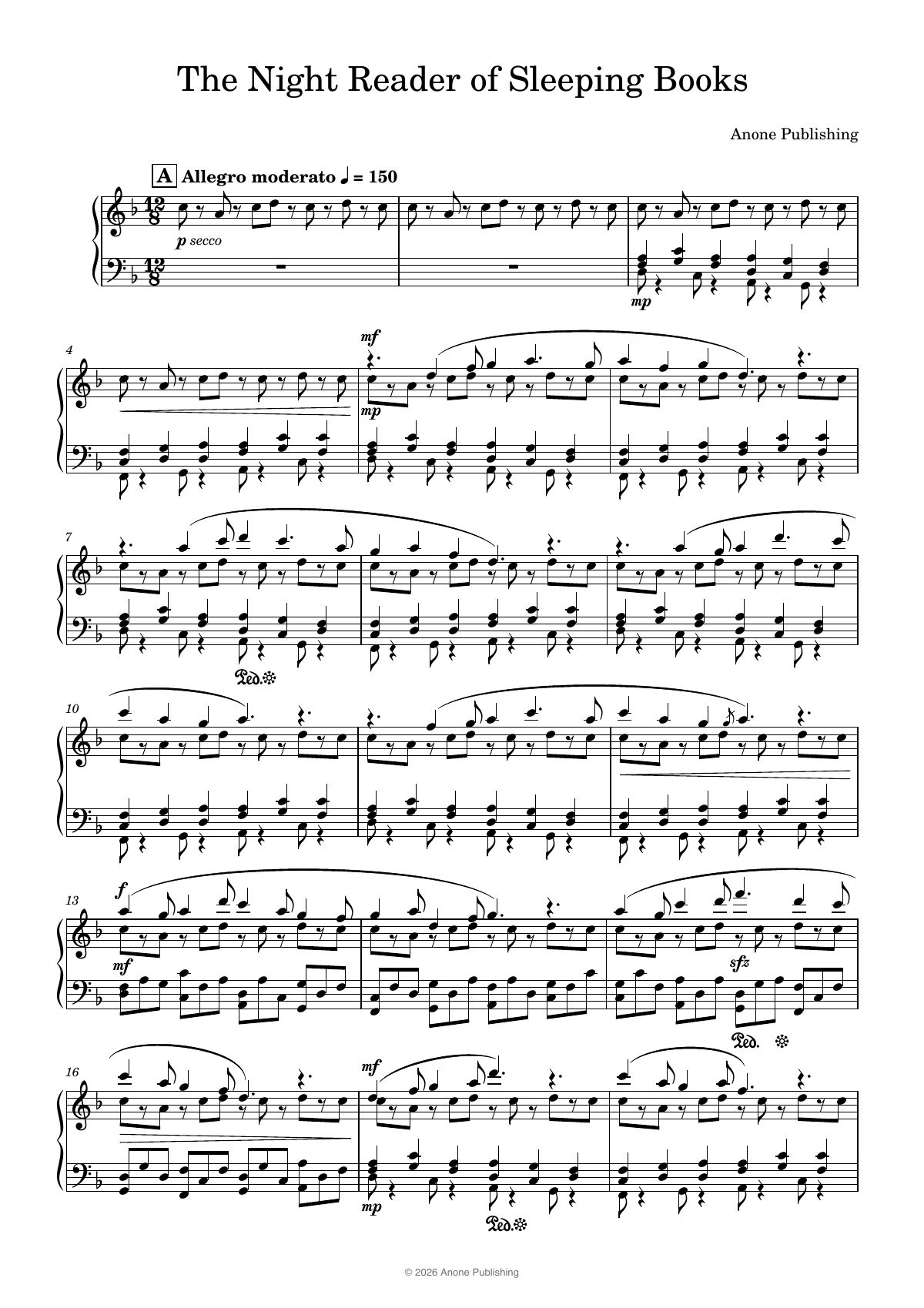
Inspired by a story about a night reader who wakes fading books by reading them aloud, this piece speaks the language of African pianism. Over a 12/8 pulse, a bell timeline tapped in the right-hand inner voice locks against a walking bass and two-note xylophone figures in a 3-against-2 cross-rhythm. The real challenge is keeping the hands rhythmically independent while the off-beat call melody floats on top. In the middle section the same five notes become a lilting F major pentatonic song, answered at each phrase end by a small nodding figure in the left hand. The song returns in full octave chords at ff before the timeline thins away and the piece comes to rest on a bare D-A fifth.
Listen
Look inside
The story
Read the story
Beneath the city library there is a stack room that holds nothing but sleeping books.
When the last person who read a book is gone, the book slowly begins to fall asleep. First the punctuation slips away. Then the kanji, the dense characters borrowed long ago from Chinese, come loose and soften into hiragana, the simple rounded script that Japanese children learn before anything else. In the end the pages turn back into plain white paper. My job is to go down there every night and read the drowsing books aloud. As long as someone is reading them, the words can hold on to the page.
In the winter of my third year on the night shift, the director, Miwa, handed me a thin volume.
"This one has gone very deep," Miwa said.
The cloth cover had faded, and the title could no longer be made out. When I opened it, most of the pages were blank. Here and there a few hiragana letters were left, like grains of sand.
"Who borrowed it last?"
Miwa tapped the borrowing card tucked inside the back cover. It was not one of the library's cards but a piece of thick cardboard with lines ruled by hand. The dates stopped forty years ago, and beneath the last one there was a single name in pencil. It had worn too faint to read.
"It was donated. No author's name, either. Nobody has ever borrowed it except the person on this card."
I began reading it that night. I could not read the white pages, so I gathered up the letters that remained and gave them my voice.
"...of... the... is... sea..."
It made no sense. But I kept going, and the next night there were a few more words than before. Beside "sea," the word "little" had come back, and before that, "blue." A book wakes up from the places where it has been read. Still, I could only speak the words that were left, and the white stayed white.
Every night before I went home, I turned the pages to check. Every word that returned belonged to the sea: waves, tide, sandy beach. But whose sea it was, the book would not tell me.
Ten days passed, and not even half of it had come back.
"It isn't enough," I told Miwa. "I'm the one reading it, and I never knew this book to begin with."
Miwa was quiet for a while, then brought out an old donation ledger. In the entry for the book, there was only the donor's address. It was in a riverside neighborhood, a fifteen-minute walk from the library.
The house still had a nameplate by the door. The man who answered was old and stooped, and when I showed him the book, he stroked the cover for a long time.
"I wrote it," he said. "When my wife was in the hospital, I wrote one chapter a week and brought it to her room."
His wife had been born in a town by the sea, and from her hospital window the sea could not be seen. So he wrote her a story about the sea. It was the tale of a small blue fish that swam up a river, searching for a woman who had gone to live on land.
"She said that once I'd written enough, we should have it bound and ask the library to keep it. She said she would be the very first to borrow it. So on the card I made, she wrote her name ahead of time."
After his wife was gone, he could not bear to keep the book at home. If it stayed in the house, he said, he would sit down every night and try to write the next chapter. He thought that at a library, someone would read it. So he gave it away.
"But nobody read it, did they."
"Your wife was its only reader," I said.
The old man had forgotten almost all of the story. Forty years is a long time. He could not remember where the fish had gone or what it had met along the way.
"But the book doesn't remember all of it either," I said. "If the two of us read it together, it might be enough."
The next night, he came down to the stack room with his cane. I read the words that were left, and whenever I stalled, he filled in what he could recall. When I read "little, blue," he went on, "The fish had no name." And on the white page, those very words seeped up, like ink rising through paper. When he said the wrong words, nothing appeared. The book accepted only what was true. Each time a line surfaced, the old man gave a small nod, and now and then he took off his glasses and rubbed his eyes.
It took three nights. The fish swam up the river, slept beneath a bridge, and on a rainy day crossed over puddles. And just before the last page, it reached the end of the river, below the window of a hospital. There the old man fell silent for a long time.
"I never wrote the ending," he said. "Before I could bring her the last chapter, my wife..."
The last page had been white from the beginning. It had not been sleeping. It had simply never been written.
I held out a pencil. He shook his head, and then he took it. With a trembling hand, he wrote a short passage on the white page. I did not read it. I did not think I should be the first to read those lines.
When I closed the book, the name on the card inside the back cover had come back, clear and dark for the first time in forty years. The handwriting was soft and leaned a little to the right. Below it, the old man added his own name. He was the second borrower.
The book is no longer in the basement. It sits on a shelf on the ground floor now, and I have taken off the blue tag that marked it as a book on the edge of sleep. Every so often someone checks it out, and little by little the list of names on the card grows longer. Each time it comes back, I return it gently to the shelf, and I never open the last page.
Score details
- Ensemble
- Piano Solo
- Instruments
- Piano
- Genre
- African music / African pianism, African art music
- Level
- Late Intermediate
- Duration
- about 2:54
- Pages
- 3 pages
- Catalog no.
- AP-M8PEM