Piano Solo
What She Carries Across
About this piece
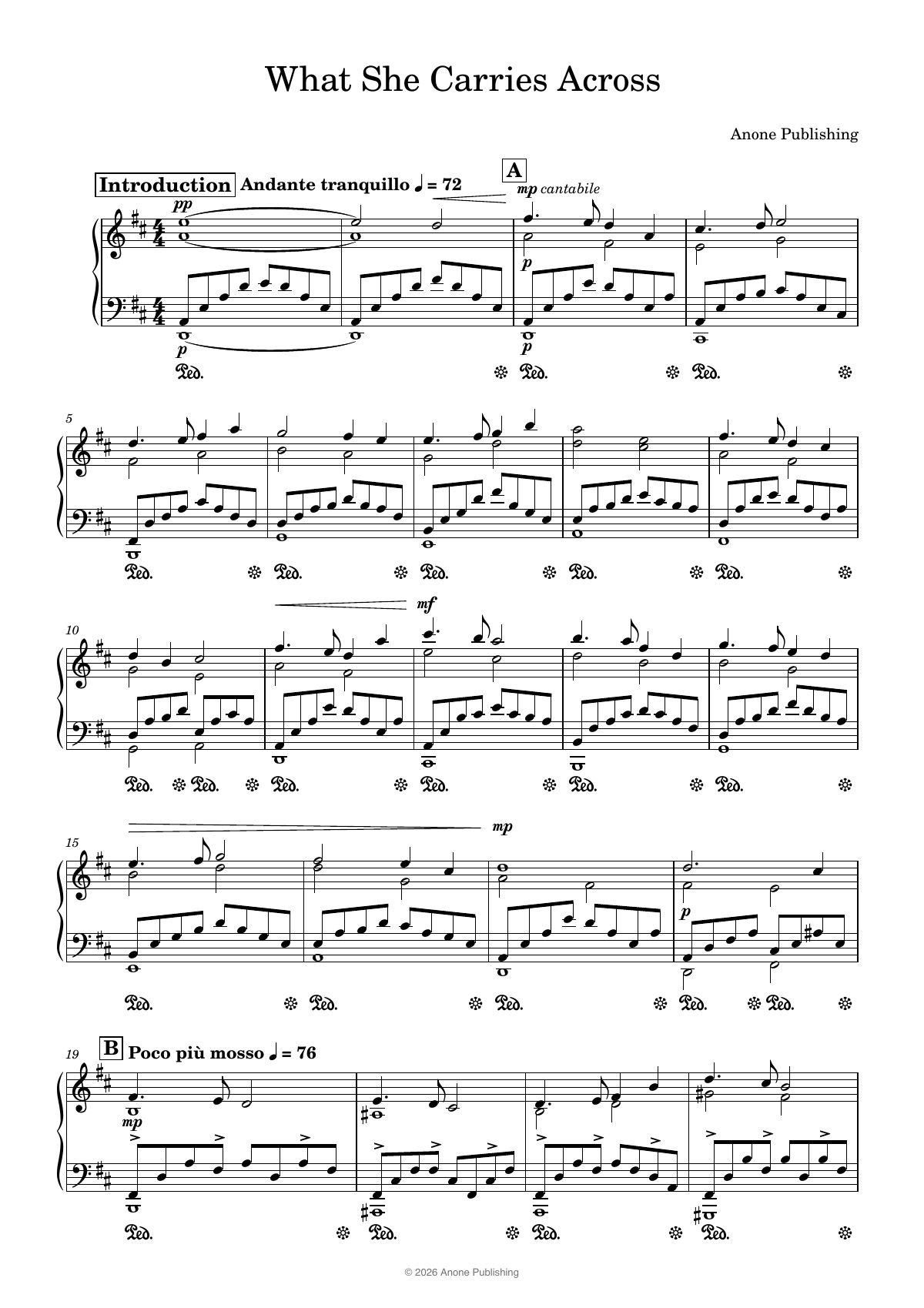
A quiet D-major piece about the hours after a rescue, when the woman who held up a collapsing bridge can finally sit down and breathe out. The opening theme falls gently from F# to D in a dotted rhythm, cradled by add9 and maj7 harmonies over flowing left-hand eighths. In the B-minor middle section, a lament bass sinks one semitone per bar while the melody climbs to a high D and spills back down in broken chords. Keep the pedal generous and let the right hand sing above the arpeggios; in the una corda coda, a distant two-note siren fades into a final D chord with the ninth still ringing.
Listen
Look inside
The story
Read the story
The bridge started to fall at twelve minutes past seven on a Tuesday morning.
I was on the bus that crosses it, the one I take every day to my high school on the far side of the river. The floor tilted with a long groan. Through the window I watched one of the steel pillars bend, slowly, the way a stalk of grass bends. Someone screamed. Someone else started praying. I just held on to the hanging strap and didn't let go.
Then the tilting stopped.
Not only the bus. The whole bridge hung there in the air, as if someone underneath had caught it and was holding it up. The driver opened the doors with great care, and one by one we stepped out and walked back toward the bank. The bridge felt strangely light under our feet. The asphalt gave a little with each step, soft as cotton.
On the grassy embankment at the end of the bridge, a woman was crouched low to the ground. She wore a gray work uniform, and her hair was tied back in a single plain knot. Her face had gone completely pale, and sweat ran down from her forehead. Both her hands were pressed flat against the earth, and her shoulders were shaking, as though she had a mountain on her back.
"Are you all right?" I asked.
She didn't lift her head. "I'm fine. Is everyone across?"
"I think so."
"Thinking isn't good enough. Count them."
I turned and counted the people gathered on the bank. The bus passengers. The people from the cars. A couple of middle school kids with their bicycles. Last of all, I watched the driver climb up the embankment, and then I said, "That's everyone."
She let out a long, long breath. A moment later there was a roar behind us, and the bridge dropped into the river. A column of water shot up, and the spray came down over our heads like rain.
The news called her "the Weight Keeper." She could take the weight of a thing into her own body and hold it there for a while. That was her power. For eleven minutes, all by herself, she had carried the weight of an entire bridge.
---
A week later, I went to see her. She lived on the fourth floor of a city-run apartment block, the kind of plain, low-rent public housing the town builds for ordinary families. Finding her had been easy. In the news footage you could read the name tag on her uniform: Miyauchi.
When Ms. Miyauchi opened the door, she was leaning on a cane.
"Oh," she said. "The girl who counted."
"I came to say thank you," I said. "And the building manager told me the elevator's broken." I held up two grocery bags.
She looked surprised for a second. Then she laughed.
Her apartment was small and very tidy. She lowered herself into a chair slowly, and her knees creaked as she sat.
"The weight I take on doesn't go back right away," she explained. "I let it drain out into the ground, a little at a time. With something the size of a bridge, it takes about a month. All that time, my body is terribly heavy. Climbing one step of the stairs takes me a full minute."
"So things like shopping—"
"Exactly. You're a big help."
I put the milk and eggs away in her refrigerator, and while I did, I asked her something.
"Why don't you join one of the hero agencies? Like the people on TV? Then there'd be someone to help you."
Ms. Miyauchi looked out the window. In the distance you could see the construction site where they were putting up a temporary bridge.
"I joined one, once," she said. "But they count the people they save. How many this month. How many more than last year. I got sick of it."
"Isn't counting important, though? You told me to count."
"That was to make sure no one got missed. So nobody got left behind. The way they counted was different. It was for measuring how great they were."
She wrapped both hands around her teacup, a small handleless cup of the kind people hold in their palms. Her finger joints were a little swollen.
"All my power does is carry someone else's weight for them. That's it. And however much I carry, that's how much I can't move. There's nothing great about it. I just want someone to reach the other side while I'm holding on."
I was quiet for a while. Then I said, "So while you're heavy, who carries your weight?"
Her eyes went wide. It was the face of someone who had never been asked that before.
"I've never thought about it," she said.
"I'll come back next week," I told her. "They say the elevator won't be fixed for a while."
---
After that, I went to her apartment three times a week on my way home from school. I carried up her groceries, took out her trash, and sometimes stayed to eat dinner with her.
One night she told me about the first time she used her power. She was seven, and it was summer. Her little brother had slipped into the river and was going under. She reached for him, but she couldn't reach, and all she could do was wish, Be light. Be light. Her brother bobbed up to the surface like a cork. And she found she couldn't take a single step from the bank.
"My mother carried me home on her back that day," she said. "I must have been just as heavy as my brother was."
Then she cried, just a little.
By the third week, she didn't need the cane anymore.
When the month was over, she came down the stairs on her own two feet and walked me out to the front of the apartment complex.
"I feel completely light again," she said. "Thank you. You carried half of it."
"I didn't carry anything," I said. "Milk and eggs, maybe."
"That was the heavy part. Things like that are the heaviest of all."
She smiled and looked up at the sky. Somewhere far off, a siren was wailing. She tilted her head a little, as if she were listening hard, and then she looked at me.
"I'm going," she said.
"Do you want help counting?"
"Please. Watch and make sure everyone gets across."
She started to run. Her gray uniform grew smaller down the street in the evening light. I ran after her. If there are people who carry the weight, then there have to be people who count, so that the ones carrying it don't get left behind. I understood that now.
Score details
- Ensemble
- Piano Solo
- Instruments
- Piano
- Genre
- Ambient and new age / New age piano (Windham Hill style)
- Level
- Intermediate
- Duration
- about 3:22
- Pages
- 3 pages
- Catalog no.
- AP-B8W9V