Piano Duet
The Town That Ran on Tabs
About this piece
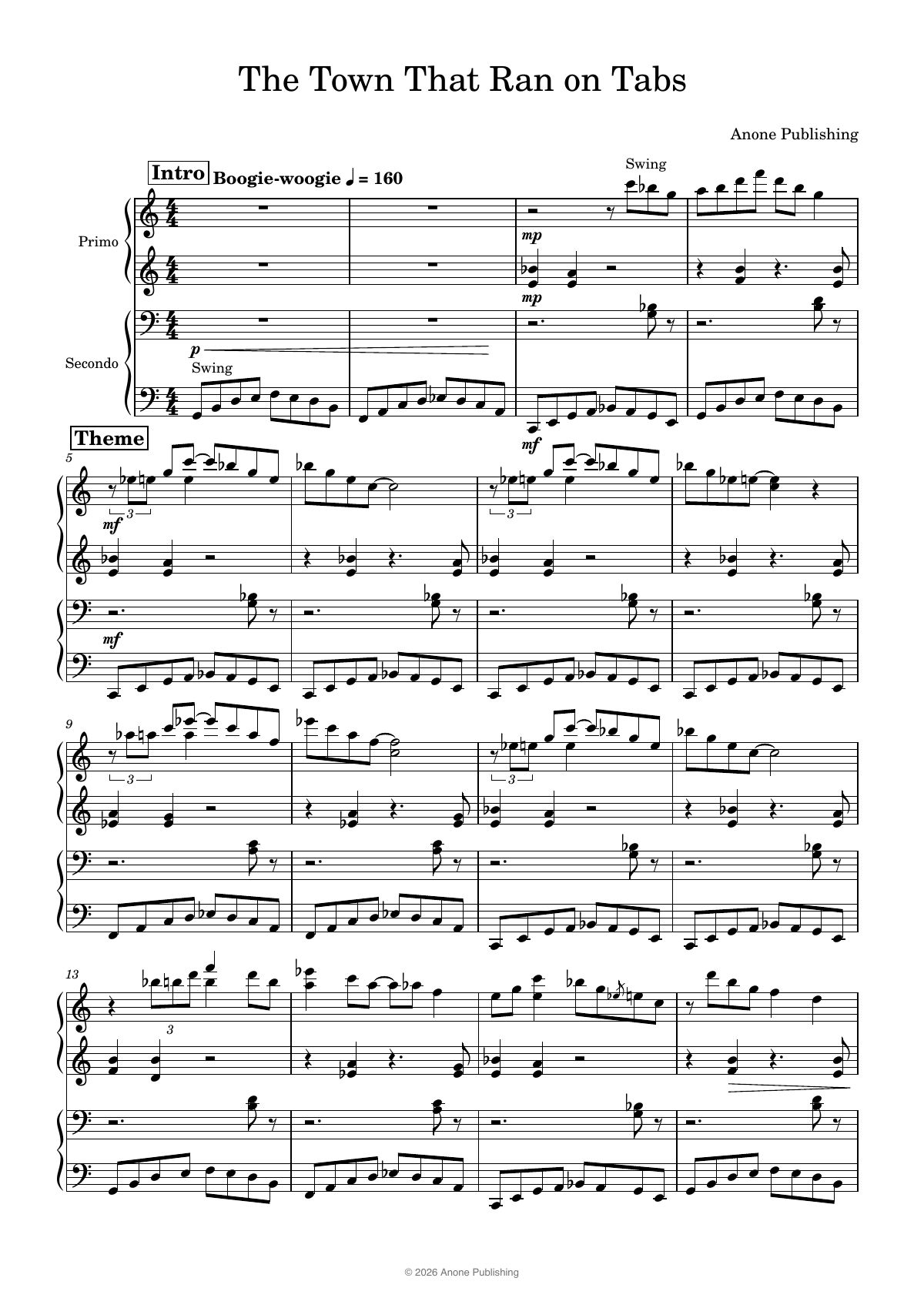
A boogie-woogie piano duet on a 12-bar blues in C, swung hard at quarter = 160. The Secondo left hand drives the classic boogie bass from the first bar to the last, while Primo and Secondo trade riffs and the tune above it. Listen for the stop-time chorus, where all four hands land a single staccato chord on beat one, and the walking-bass chorus, where the players swap two-bar solos. Crushed notes sliding from the minor to the major third open every phrase of the tune; keep them quick and light for that barroom bite. The music grew out of a story about a small fishing town that keeps its trade going on a shopkeeper's tab books after the bank branch closes.
Listen
Look inside
The story
Read the story
The notice came on a February morning, with old snow still lying in the corners of the streets. The local branch of the credit union, the only bank of any kind in our small harbor town, would close at the end of March. The town's single cash machine would be taken out along with it. The next nearest branch was in the neighboring city, fifty minutes away by bus, and the bus ran only four times a day.
I am the whole of the town hall's finance section. My section chief told me to put together materials for a public meeting, so I lined up the numbers. Population: two thousand one hundred. Four in ten were sixty-five or older. Most of the accounts where their pensions were paid sat in that one branch.
On the night of the meeting, fewer than half the folding chairs in the community hall were filled. The man from the credit union bowed low and explained that a bank on wheels, a van fitted out as a mobile branch, would visit twice a month. Twice a month. Someone laughed, and the laugh died almost at once.
The hand that went up belonged to Chiyo, who kept the general store facing the harbor. She was past seventy and her back had rounded, but her voice carried to every corner of the room.
"My shop has always run on tabs," she said. "Why can't the rest of you do the same?"
The man from the credit union looked lost. My chief looked at me. I pictured Chiyo's store. Beside the register sat a pile of plain school notebooks held together with rubber bands. Masaru the fishmonger, kerosene, 3,200 yen. Young crew from the fishing co-op, five boxed lunches. Names, goods and amounts, all in pencil. Some people came in at the end of the month to settle up. Others simply left a fresh-caught sea bream on the counter and said nothing.
The following week I went to see her.
"Would you let me look at your notebooks?"
Chiyo raised her eyebrows, but she went into the back and carried out a cardboard box. There were twenty years of them.
I took them to the town hall and spent night after night typing in the figures. What I found was that almost none of the town's money ever left the town. Masaru bought his kerosene at Chiyo's store. Chiyo bought her fish from Masaru. The young men of the fishing co-op ate Chiyo's lunches, and Chiyo's grandson worked for the co-op. Hardly any cash changed hands, yet the debts went round and round on paper, and by the end of most months they very nearly cancelled out. Cash was needed only for whatever did not.
Added up over twenty years, the money that had moved through those notebooks came to nearly three times the cash that had actually changed hands. Losing the branch would not stop the town's trade. It would only shut off the way we covered the leftover gaps. I made a table of those gaps, month by month. Even in the worst months, they came to about four hundred thousand yen for the whole town.
I took a plan to my chief. We would gather all the shops' tab books into one, and the town hall would keep the ledger. At the end of each month we would net everything out and settle only the balance in cash. That cash would all be moved together on the days the mobile branch came.
My chief turned the pages for a long time without speaking.
"Do you think the town council will pass this?"
"No, I don't."
"Well, you're honest."
Sure enough, the council fought over it. Councilor Miyoshi asked whether the town hall meant to set itself up as a moneylender. Another member pointed out that if the ledger ever leaked, the whole town would know who owed what to whom. That was a fair point. In our town, you might know perfectly well who was running up a tab, but you did not say it out loud.
On the night before the vote, Chiyo came to the town hall. The offices had closed, and I was the only one still there.
"What exactly are you planning to do with my notebooks?"
I explained it all: the netting out, how much less cash we would need, how the money would stay inside the town. Chiyo heard me through to the end. Then she shook her head.
"A tab book isn't just numbers. There was a year Masaru couldn't pay for three months. His wife was in the hospital. I wrote it all down, and I never once asked him for it. Once it's a town hall ledger, could you do that?"
I had no answer. Put something into the rules, and every exception becomes a violation.
"I'll do the writing," Chiyo said. "What the town hall should be thinking about is where the cash comes from at the end of the month when a shop comes up short. That's your job, isn't it?"
The next day I rewrote the plan. Each shop would keep its own tab book, as it always had. The only thing the town hall would hold was a small fund, to make short loans to any shop that found itself short of cash at the end of the month. The money would come from what the town had been paying the credit union every year to keep the cash machine running, which would now be freed up. Only the shopkeepers would ever see what was inside their books. The town hall would know only the totals.
Councilor Miyoshi still looked sour. But he said, "So we're not a moneylender after all, just the one holding the strongbox key," and raised his hand. The plan passed, seven votes to five. At the far end of the public gallery, Chiyo stood up without clapping, said it was time to open her store, and left before anyone else.
In April, a vending machine went in where the cash machine had stood. Twice a month, the mobile branch parked in the harbor lot. On those days Chiyo closed her store, gathered up the cash from all the town's shopkeepers, and took it there herself. People said that on the first trip she rode the bus home with the envelope clutched on her lap and never once closed her eyes. From the second trip on, Masaru drove her there and back in his little pickup truck.
At the end of summer, the fund made its first loan. The application gave the name of the shop and the amount, and nothing else. The line for the reason had been left blank. I stamped my seal on it just as it was.
On the day of the town's autumn festival, I stopped by Chiyo's store. There was one more notebook in the pile beside the register. On its cover, in pencil, she had written Town Hall.
"That one's yours," Chiyo said. "Three bottles of sake for the festival. End of the month is fine."
Score details
- Ensemble
- Piano Duet
- Instruments
- Piano
- Genre
- Blues / Boogie-woogie, Piano blues, Barrelhouse
- Level
- Intermediate
- Duration
- about 1:44
- Pages
- 5 pages
- Catalog no.
- AP-24FC7